43. Parts Work for Parents: Meeting the Different Versions of You
Have you ever had a moment in parenting where you thought:
- Why does part of me want to be calm and connected… and another part of me just want to shut down or walk away?
- Why do I crave closeness with my kids, but feel overwhelmed the moment they actually need me?
- Why do I logically know this is just a phase, but emotionally feel like I’m at my breaking point?
- Why does part of me feel proud of how much healing I’ve done… and another part feel disappointed that I’m not further along?
- Why does my body react like something bad is about to happen, even when my mind knows it isn’t?
- Why do I give my child so much grace, but struggle to offer any to myself?
If any of those questions landed, you’re not alone.
And more importantly - nothing is wrong with you!
What you’re experiencing isn’t a lack of patience, discipline, or emotional intelligence. It’s internal conflict - an emotional tug-of-war between different needs, fears, and protective responses inside you.
Parenting has a way of bringing this conflict to the surface like almost nothing else.
Why Parenting Triggers Inner Conflict
Parenting doesn’t just ask for our skills.
It asks for our nervous system.
And when the nervous system senses threat - whether that threat is real or perceived - it doesn’t consult parenting books or our best intentions. It calls on the parts of us that learned, long ago, how to keep us safe.
That’s why parenting can reveal versions of ourselves we didn’t even know were still there.
These parts don’t always show up at work.
Or with friends.
Or even in adult relationships in the same way.
But put us in a moment where our child is melting down, rejecting us, ignoring us, or pushing against limits - and suddenly, something else steps forward.
When that happens, it can feel disorienting. Like you’re watching yourself from the outside. Like you’ve lost access to the calm, grounded version of yourself and are reacting in ways you don’t recognize - or don’t like.
And most of us respond the same way.
We judge ourselves.
What’s wrong with me?
Why can’t I get it together?
Why am I like this?
We label these moments as “bad parenting” and try to control, fix, or eliminate them.
But what if these moments aren’t proof that you’re broken?
What if they’re actually showing you something important about how your inner world is organized?
What Is Parts Work?
Parts work is a therapeutic framework rooted in Internal Family Systems (IFS) - a model that’s been used for decades in trauma therapy, attachment work, and nervous system healing.
And while the theory runs deep, the core idea is actually very simple:
We are not made up of one single, consistent personality.
We are made up of parts.
Different inner voices, reactions, and impulses that show up in different moments - especially under stress.
You already use this language all the time:
“Part of me wants to go out, and part of me wants to stay home in pajamas.”
A part of you wants to stay patient.
A part of you wants the problem solved immediately.
A part of you feels capable and confident.
A part of you feels overwhelmed and unsure.
Parts work doesn’t ask, Which one is the real you?
Because the answer is: all of them.
And here’s what matters most - every part exists for a reason.
Even the parts you don’t like.
Even the parts you wish would go away.
Even the parts that show up in ways you later regret.
In IFS, parts aren’t viewed as flaws or dysfunction. They’re adaptive. They formed in response to something - often early in life - to help you cope, survive, belong, or stay safe.
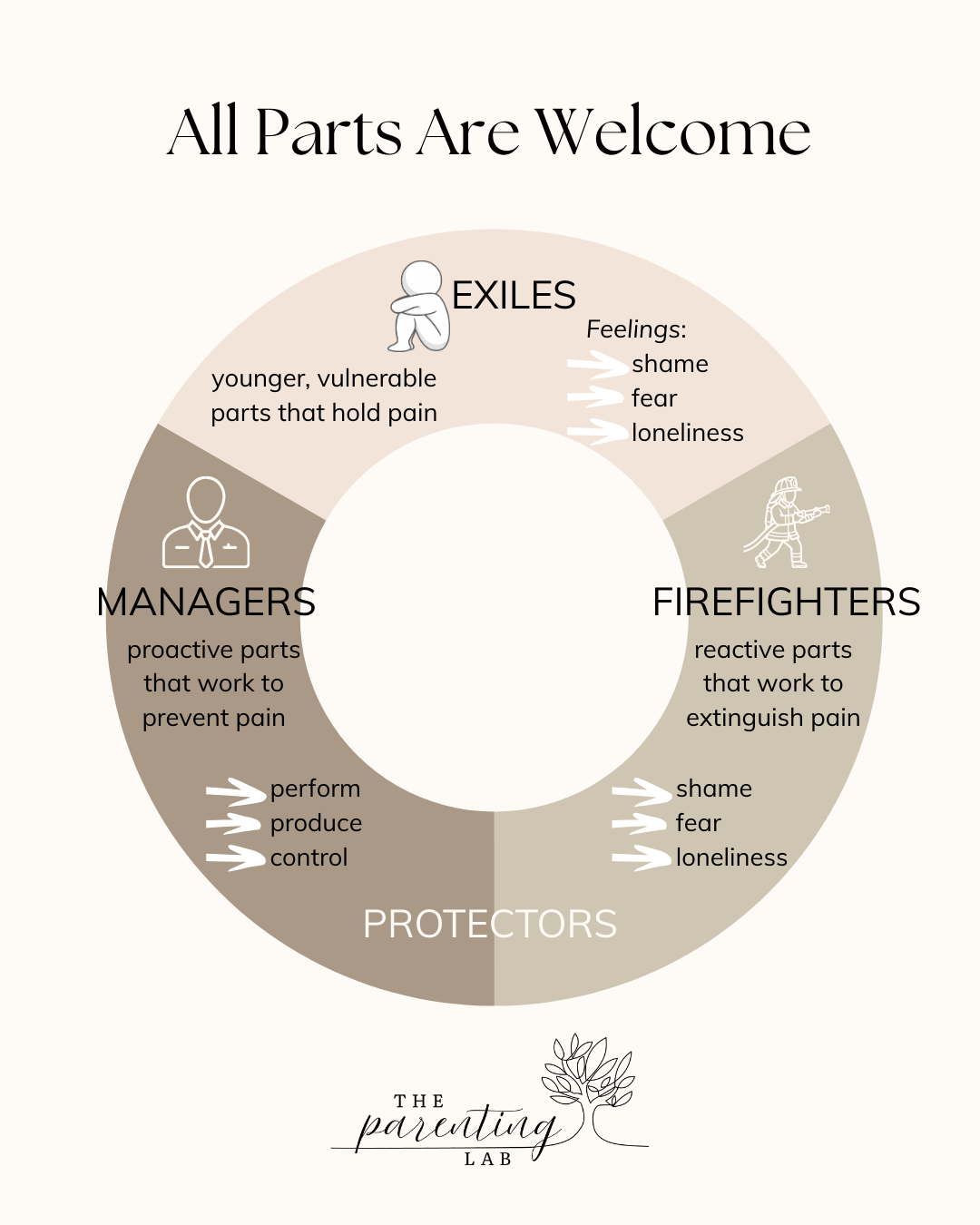
The Three Main Types of Parts in Parenting
Parts work helps us organize our inner world so we’re not just reacting blindly. While you don’t need to memorize these terms, having language can be incredibly clarifying.
1. Managers: The Parts That Try to Keep Things Together
Managers are proactive, protective parts focused on prevention and control. Their goal is simple: don’t let things fall apart.
In parenting, Managers often show up as:
- Over-preparing
- Over-explaining
- Perfectionism
- Rigidity
- Constantly scanning for what could go wrong
These parts are often responsible, capable, and deeply invested in doing things “right.” They care enormously - and they often carry a heavy sense of responsibility.
Managers are the parts that read the books, listen to the podcasts, and try to apply everything perfectly.
They aren’t the enemy.
They’re trying to help.
But when Managers feel overwhelmed - or when their strategies stop working - the system calls in backup.
2. Firefighters: The Parts That Need the Feeling to Stop
Firefighters are reactive parts. Their job is immediate relief.
They’re less concerned with long-term lessons or parenting philosophy and more focused on making the discomfort stop now.
Firefighters may show up as:
- Yelling or snapping
- Shutting down emotionally
- Threatening consequences you don’t intend to enforce
- Numbing behaviors later (scrolling, snacking, binge-watching)
Firefighters don’t come online because you don’t care. They show up because the system feels flooded - and it needs an escape plan.
3. Exiles: The Parts Carrying Old Pain
Underneath Managers and Firefighters are the most tender parts of all - the Exiles.
These parts carry old experiences of feeling unseen, unheard, unsafe, rejected, or alone. They’re often younger parts (think inner child) formed early in life when certain feelings were too overwhelming to process.
The word Exile doesn’t mean these parts are bad or banished. It simply means they’ve been pushed away because they hurt too much to feel directly.
Managers work hard to prevent Exiles from being activated.
Firefighters rush in when they break through.
And parenting activates Exiles more often than we realize.
A child’s “no” can feel like rejection.
A child’s dysregulation can feel like danger.
A child’s independence can feel like loss.
Not because you’re fragile - but because these moments activate old learning in the nervous system.
How Parts Interact in Real Life
Imagine your child is pushing back on a limit - again.
Your Manager steps in first. You stay calm. You explain. You reason. You hold the boundary.
But the moment escalates.
Your body tenses. Your heart rate rises. An Exile gets activated - maybe the part that feels powerless, disrespected, or ignored.
Suddenly, a Firefighter jumps in.
You raise your voice.
You shut down.
You end the conversation abruptly.
Later, when the house is quiet, the Manager comes back online.
Why did I react like that? Tomorrow I’ll do better.
This cycle doesn’t happen because parents lack insight or skill.
It happens because different parts are taking turns driving - without coordination.
Parts work helps slow this down.
Why Parts Work Is So Healing for Parents
1. It Reduces Shame
Instead of asking What’s wrong with me? we ask What part of me is activated right now?
Shame loosens its grip when understanding takes its place.
2. It Creates Space and Choice
Recognizing which part is present creates a pause - and with it, the ability to repair rather than spiral.
3. It Builds Compassion for You and Your Child
When you understand your inner system, your child’s behavior makes more sense too. Connection grows through understanding, not perfection.
How to Start Using Parts Work in Everyday Parenting
You don’t need to identify every part or fix anything in the moment. The goal is awareness and relationship, not control.
Step 1: Name the part (without judgment).
“A part of me feels overwhelmed right now.”
Step 2: Get curious.
“What is this part trying to protect me from?”
Step 3: Acknowledge and thank the part.
Intention and behavior are not the same. This feels counterintuitive, but having an inner dialogue that says, "I see you, thank you for trying to keep me safe" helps to soften the part that is activated.
Step 4: Bring safety to the body.
A breath. A hand on your chest. Grounding through the senses.
Step 5: Model this for your child (when appropriate).
“A part of me got overwhelmed, and I’m calming it down.”
A Different Way to Understand Yourself
If there’s one thing I hope you take from this, it’s this:
Those moments of inner conflict aren’t evidence that you’re failing.
They’re moments when different parts of your system are responding to stress, protection, and old learning - all at once.
Parts work doesn’t ask you to suppress or eliminate these parts.
It asks you to understand them.
And when you do, parenting becomes less about self-control and more about self-leadership.
Because when a moment feels hard, something inside you is trying to help.
Your job isn’t to shut it down - it’s to understand it.
And that’s where real change starts.
♥ Your Parent Coach, Brittney