58. Re-Parenting Yourself: The Healing Work That Changes Your Parenting
Motherhood has a way of bringing everything to the surface.
Not just love, connection, and joy - but also exhaustion, overwhelm, resentment, grief, emotional triggers, and old wounds we thought we had moved past long ago.
And for many women, that reality can feel confusing.
You love your children deeply. You want to parent differently. You’ve read the books, learned the tools, followed the parenting accounts, and promised yourself you would break the cycle.
But then your child melts down… and suddenly you feel reactive. Overwhelmed. Disconnected from the kind of parent you want to be.
So many mothers quietly ask themselves the same question:
Why does parenting feel so triggering?
The answer often has less to do with your child’s behavior - and more to do with the parts of you that still need care, healing, and support.
That’s where the work of re-mothering yourself begins.
What Does Re-Mothering Yourself Mean?
Re-mothering yourself is the process of learning how to give yourself what you may not have consistently received growing up.
Not perfectly.
Not all at once.
And not from a place of blaming your parents.
It’s about recognizing that every person grows up with moments where something important was missing.
Maybe you needed more emotional support and were told to “toughen up.” Maybe you needed comfort but learned to handle things alone. Maybe there wasn’t space for your emotions, your sensitivity, your needs, or your voice.
Over time, we adapt to the environments we grow up in.
We learn what gets us connection and what risks losing it. We become easier, quieter, more independent, more helpful, less emotional, or less needy - not because that’s who we truly are, but because it felt safer that way.
Then we grow up and become parents ourselves.
And suddenly, those same patterns begin showing up right in the middle of everyday parenting.
Why Parenting Feels So Triggering
Parenting doesn’t just engage the adult version of you.
It touches every version of you that learned how to survive before.
This is why certain parenting moments can feel bigger than they “should.”
Your child’s emotions may feel overwhelming because somewhere along the way, you learned that big feelings weren’t safe or manageable. Your child’s constant needs may create resentment because you had to become independent too early yourself. A lack of appreciation on Mother’s Day may hurt more deeply because it touches an older wound of feeling unseen.
These reactions are not random.
They are connected to your nervous system, your attachment experiences, and the emotional patterns you learned long before becoming a parent.
And until those wounds are acknowledged, they continue influencing the way you show up.
The Hidden Problem: Looking to Our Children to Heal Us
One of the most important parts of this conversation is understanding what happens when our unmet needs remain unaddressed.
Because those needs don’t simply disappear.
We naturally begin looking for them to be met.
We want to feel appreciated, so we hope our children notice everything we do. We want to feel valued, so their behavior starts to feel connected to our worth. We want connection, so we unconsciously lean on our children emotionally in ways they were never meant to carry.
This isn’t intentional or manipulative.
It’s human.
But it can create pressure our children were never meant to hold.
Your child’s job is not to regulate your worth. They are not responsible for healing your childhood wounds or filling emotional spaces that were left empty in your own story.
That’s why re-mothering matters.
Because real healing begins when we stop trying to resolve our past through our children and start learning how to care for ourselves differently instead.
How Re-Mothering Interrupts Generational Patterns
There’s a common idea in the parenting world that we should “parent our children the way we wish we had been parented.”
While the intention behind that idea is understandable, it misses something important:
Your children are not you.
They do not have the same wounds, experiences, or emotional needs that you did.
If all we give our children is everything we never had, they can end up full of what we needed - while still feeling unseen in the ways that mattered to them personally.
Real generational healing happens differently.
It happens when we begin healing ourselves.
When we learn how to respond to our own overwhelm with compassion instead of criticism. When we stop abandoning ourselves emotionally in difficult moments. When we create internal safety instead of waiting for someone else to give it to us.
That work changes how we parent naturally.
Not because we are trying harder, but because we are relating to ourselves differently.
What Re-Mothering Yourself Actually Looks Like
Re-mothering is not a complicated or “woo-woo” process. It’s grounded in simple but powerful shifts.
1. Noticing Instead of Overriding
Instead of immediately pushing through your feelings, fixing them, or judging yourself for having them, you begin by noticing them.
You pause long enough to acknowledge:
This feels hard.
I’m overwhelmed right now.
Something deeper is being touched here.
Awareness is where healing begins.
2. Soothing Instead of Pushing Through
Many of us learned to ignore our needs in order to stay productive, helpful, or emotionally manageable.
Re-mothering invites a different response.
Sometimes it looks like:
taking a breath
resting without earning it
stepping away for a moment
softening your internal voice
allowing yourself support
These small moments begin creating emotional safety within your nervous system.
3. Creating Internal Safety
Healing doesn’t always start with changing your external circumstances. Often, it begins by becoming a steadier presence for yourself internally.
That might sound like:
“It makes sense that this feels overwhelming.”
“You don’t have to do this perfectly.”
“I’m here with you.”
Over time, your relationship with yourself begins to change.
4. Protecting Yourself Through Boundaries
Re-mothering is not only nurturing - it is also protective.
It means:
not overextending constantly
not abandoning yourself to keep everyone else comfortable
recognizing your limits
honoring your emotional needs
It is the practice of staying with yourself in moments where you once learned to leave yourself behind.
Healing Your Inner Child While Parenting
One of the most powerful parts of re-mothering is reconnecting with the younger parts of yourself that still need care.
Not to relive the past, but to respond to it differently.
You might ask yourself:
What did I need growing up that I didn’t consistently receive?
What did I learn I had to do to feel safe or loved?
How do those patterns still show up in my parenting today?
These questions are not about blame.
They are about awareness.
Because awareness creates choice.
And choice creates the possibility for change.
You Don’t Have to Heal Perfectly to Change Your Parenting
One of the biggest misconceptions about healing is the idea that you need to become completely healed before you can parent well.
You don’t.
Healing is not perfection. It is practice.
It is returning to yourself over and over again with more awareness, more compassion, and more intention than before.
Your children do not need a perfect parent.
They need a parent who is willing to stay present, repair when necessary, and continue growing.
The Work of Re-Mothering Yourself
Re-mothering yourself is not about becoming someone entirely new.
It’s about learning how to care for yourself in the moments where you once learned to disconnect, suppress, or survive.
And when you begin doing that work, everything starts to shift.
Your parenting becomes more grounded.
Your reactions become more understandable.
Your relationships become more connected.
And your children experience a different kind of emotional inheritance.
That’s how generational patterns begin to change.
Not through perfection.
But through awareness, healing, and the willingness to respond differently.
Companion Resource
If this resonated with you, I created a companion ebook called:
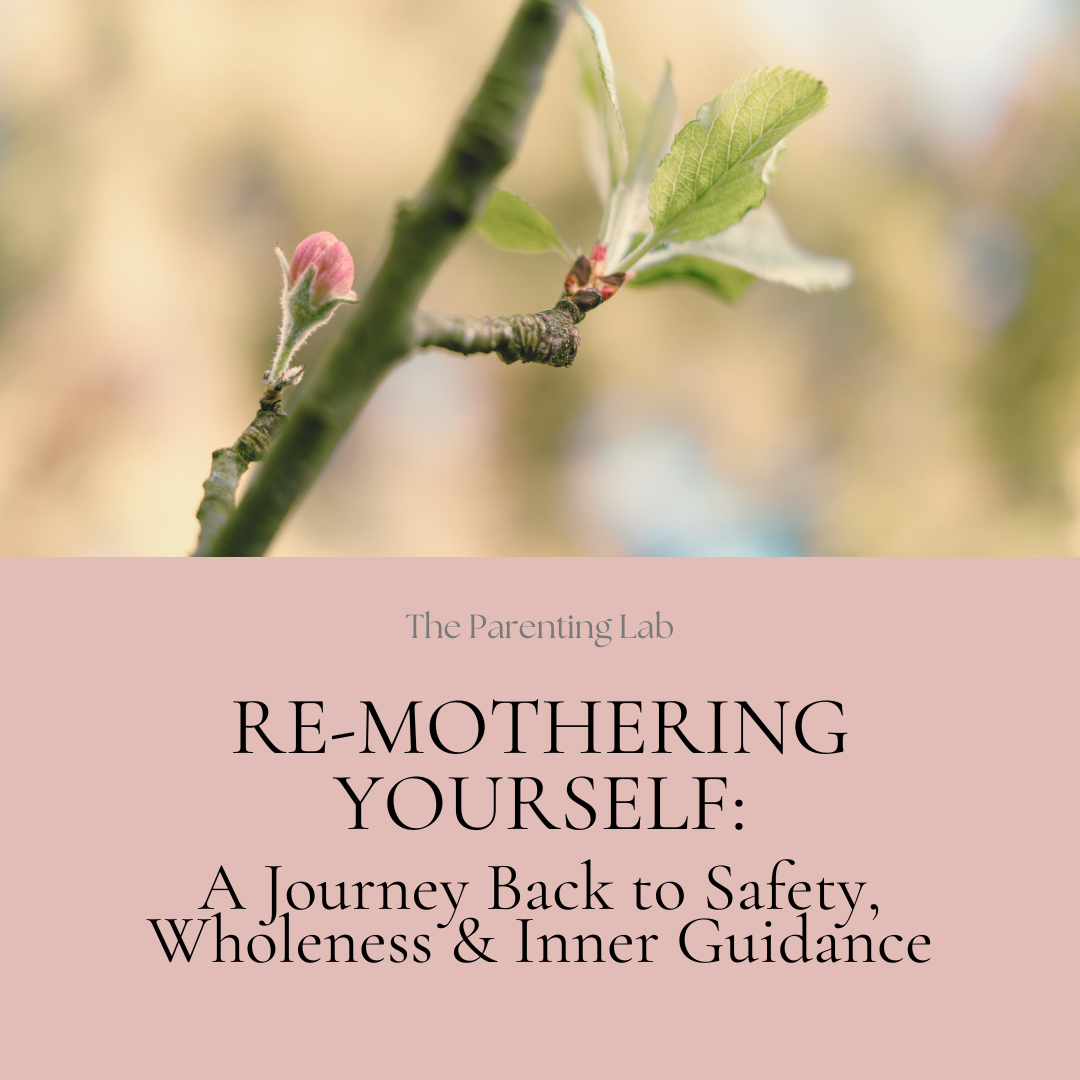
Re-Mothering Yourself: A Journey Back to Safety, Wholeness & Inner Guidance
This guided resource is designed to help you go deeper into:
healing childhood wounds
understanding parenting triggers
nervous system regulation
emotional safety
self-compassion
journaling and reflection
generational healing
You can find it at theparentinglab.org.
And if you’d like more conversations around attachment, nervous system healing, motherhood, emotional regulation, and conscious parenting, be sure to follow The Parenting Lab Podcast.
♥ Your Parent Coach, Brittney
